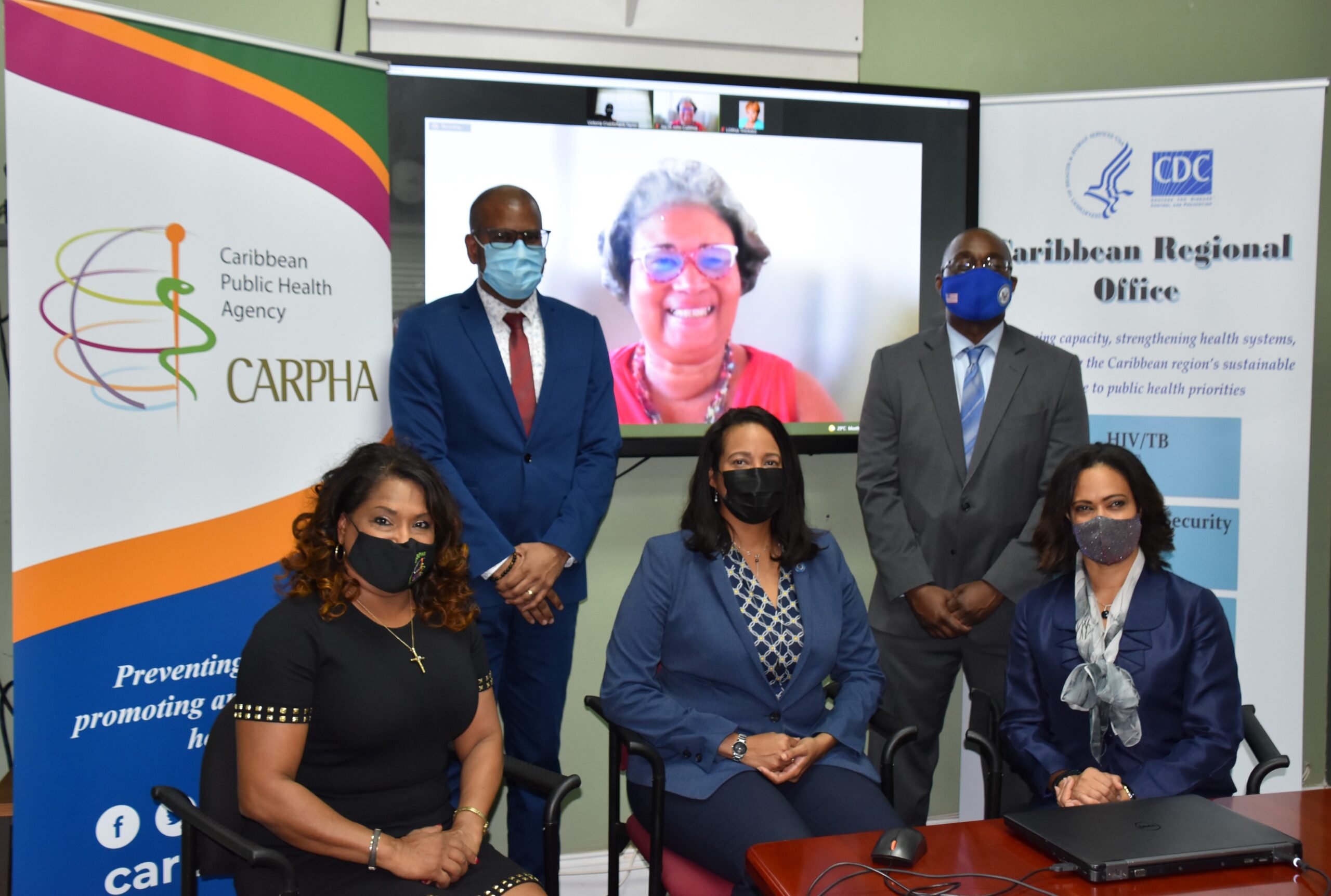
Regional Response to Novel Corona-virus is ‘Regionalism Working’ – Prime Minister Chastanet
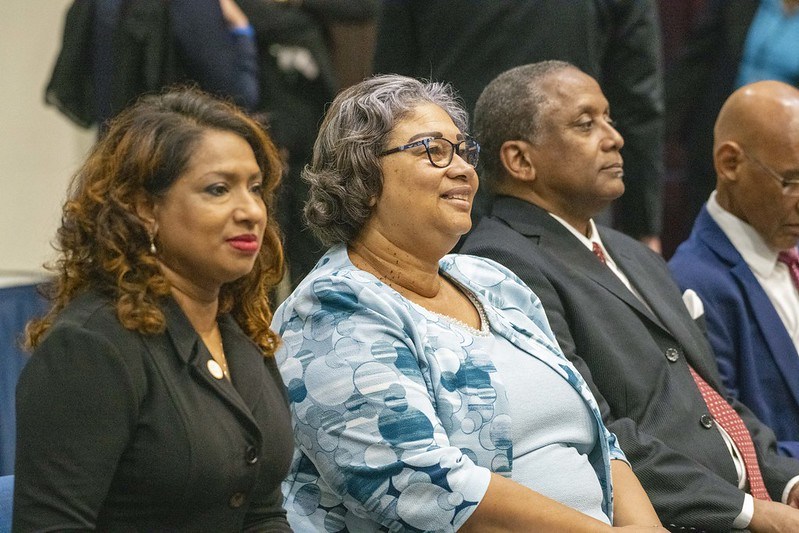
CARPHA Executive Director, Dr. Joy St. John (2nd from left) lead a team to the 31st CARICOM Intersessional Meeting
Prime Minister of Saint Lucia and Outgoing Chairman of the Conference of Heads of Government of CARICOM, Hon. Allan Chastanet, has lauded the Region’s response to the Novel Corona-virus as “regionalism working”.
The Prime Minister said the approach reminded him of the importance
of being part of a group that in times of emergency had your back. He
expressed gratitude to the Regional Security System (RSS) and Caribbean Regional Public Health Agency (CARPHA) for their role in the Region’s response, particularly as it related to transporting and quickly testing samples.
“You had Saint Lucia’s back and we thank you. This is what being part of CARICOM is about,” Prime Minister Chastanet said.
He was speaking at the opening of the Thirty-First intersessional
Meeting of the Conference of Heads of Government of CARICOM being held
at the Lloyd Erskine Sandiford Centre in Barbados, 18-19 February, 2020.
In his remarks, Prime Minister Chastanet identified a number of
issues that were of significance within the Region. Among them were
climate change, blacklisting by the EU, adversities facing small island
states in the international community, the ongoing situation in
Venezuela, and the withdrawal of correspondent banking services from the
Region.
Speaking on the issues of correspondent banking and de-risking, he
reported that in light of the threat to financial institutions of losing
critical relationships with banks in the United States, the matter was
taken to Washington by delegation led by Antigua and Barbuda Prime
Minister, the Hon. Gaston Browne, following a meeting that was held in
Saint Lucia.
“We have moved the needle on de-risking and the OECS is working on a single compliance department,” he reported.

He further reported that another CARICOM delegation interfaced with
the European Union on the troubling issue of blacklisting. He stated
that Member States of the Community, continued to take the necessary
steps to comply with the demands of the regulating agencies, but while
they do, countries in the Region were still being penalized. According
to him, some countries remained on a grey list, while one Member State
still remained on the blacklist.
“We must continue working until all of us are off the
list, but more importantly, we must make every effort to ensure this
undemocratic and discriminatory practice of a public blacklist is
discontinued,” Prime Minister Chastanet said.
He also used the opportunity to welcome Canadian Foreign Affairs Minister, Francois-Philipe Champagne
who attended the opening and would be engaging the Heads during the
Conference. The Prime Minister said Canada’s relationship with the
Caribbean dated back to Prime Minister Trudeau’s father in the 1960s. He
said that he looked forward to continuing to strengthening ties with
that country. He said while the ties have been impressive, he believed
there was more that could be done and asked for Canada’s voice and
leadership, particularly as it related to climate change, de-risking and
blacklisting.
The Saint Lucian Prime Minister also noted that despite the
withdrawal of some Canadian Banks from the Region, there continued to be
major Canadian investments through both public private partnerships and
privately.
“We are also keen on the reinstatement of visa-free
access to Canada and support from Canada in fields where it has achieved
world class status such as Education, Health Care and Security,” Prime
Minister Chastanet said.
Turning to the matter of Brexit,
PM Chastanet said that since 2017, and under the umbrella of CARIFORUM,
the Community has been involved in discussions with the United Kingdom
on an agreement that would govern trade post-Brexit and replicate the
effects of the CARIFORUM-European Union Economic Partnership Agreement
(EPA). This, he said, would ensure continuity in the preferential
trading relationship and avoid disruption in preferential trade between
the CARIFORUM States and the United Kingdom.
In closing, Prime Minister Chastanet referred to questions he had
asked the Heads at the beginning of his tenure as Chairman regarding the
level of satisfaction of CARICOM citizens with their performance and if
they were pushing themselves hard enough. He said that those questions
were still relevant today as the people of the Caribbean Community had a lot riding on the integration process.
You may also be interested in:
Mensaje de fin de año de la Secretaria General de la Comunidad del Caribe (CARICOM), Dra. Carla N. Barnett
We have come to the end of another year during which strenuous efforts have been made to ensure that the integration process improves the lives of the people of the Caribbean C
Mensaje de fin de año de la Secretaria General de la Comunidad del Caribe (CARICOM), Dra. Carla N. Barnett
We have come to the end of another year during which strenuous efforts have been made to ensure that the integration process improves the lives of the people of the Caribbean C
La CSME, la seguridad alimentaria y la financiación climática encabezan la agenda de la Cumbre de CARICOM en las Bahamas.
The CARICOM Single Market and Economy (CSME); food security; climate change and climate finance; health; and security will be among the major topics when Heads of Government ofRelated Stories
CARPHA: The Decision to Impose Travel Entry Requirements Belongs to the National Authorities
Port of Spain, Trinidad and Tobago.
World Diabetes Day 2021
“Diabetes causes death and disability. Complications from diabetes can lead to heart attack, stroke, blindness, kidney failure and lower limb amputation. This