
CELAC important to development of the region, says PM Douglas
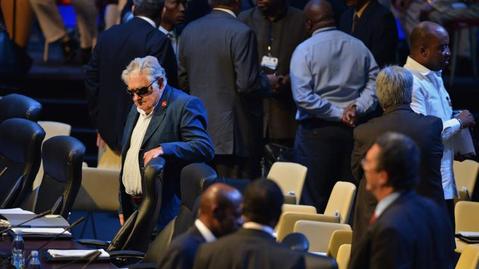
HAVANA, CUBA, JANUARY 29TH 2014 (CUOPM) – St. Kitts and Nevis’ Prime Minister, the Right Hon. Dr. Denzil L. Douglas said Tuesday that the Community of Latin American and Caribbean States (CELAC) is critical for the future development of the countries in the Latin America and the Caribbean.
Arriving with other leaders from the Caribbean for the Second Meeting of CELAC, Prime Minister Douglas said he is hoping for fruitful exchange that would benefit the people of the Western Hemisphere
“We recognize CELAC to be quite timely in its formation because it gives us an opportunity as Heads of State and Heads of Government of the Caribbean and Latin America to discuss and determine a number of challenges that we have been facing within the hemisphere in recent times,” said Prime Minister Douglas.
Dr. Douglas said he is certain that the political statement that would be made in the Plan of Action “would defiantly help to alleviate some of the problems that the people of the Caribbean and Latin America.”
Dr. Douglas is among heads from 33 nations including Trinidad and Tobago, St. Vincent and the Grenadines, Antigua and Barbuda, Dominica, The Bahamas and Grenada, attending the meeting.
Last Saturday, the Community of Latin American and Caribbean (CELAC) member countries’ National Coordinators approved a document which declared Latin America and the Caribbean, a Zone of Peace.
The agreement is a landmark event for the region, affirmed Cuban Deputy Foreign Minister His Excellency Abelardo Moreno during a press conference at the site of the 2nd CELAC Summit, the multi-purpose exhibition hall Pabexpo, in Havana.
The draft, and all other Summit declarations under discussion, were considered for approval by foreign ministers including St. Kitts and Nevis’ the Hon. Patrice Nisbett and by heads of state and government during the January 28-29.
The Zone of Peace declaration would commit CELAC member countries to respect the principles and norms of international law, and to seek peaceful resolution of disagreements.
The agreement would eliminate the threat and use of force in the region, said Moreno, Cuban national coordinator for the organization founded in 2011.
The document also reflects the commitment of member countries to strictly comply with their obligation to refrain from interfering in the internal affairs of other nations.
Moreno reported that, in the approved text, the organization’s 33 independent nations reaffirm their commitment to national sovereignty and self-determination, to the right of all countries to choose their own political, economic, social and cultural system – a position which is essential to peace among neighboring countries.