Energy
The work of the Community in the pursuit of sustainable energy is grounded in the CARICOM Energy Policy and the associated strategic framework known as the Caribbean Sustainable Energy Roadmap and Strategy (C-SERMS), both of which guide energy transformation across Member States.
The CARICOM Secretariat implements the regional energy work programme and helps translate the CARICOM Energy Policy into coherent action across Member States. It supports policy development, harmonisation, and institutional strengthening to ensure secure, affordable, and sustainable energy access while minimising environmental harm. The Secretariat supports research, regional energy planning, and information systems that enable rational energy decision-making. It collaborates with governments and partners to mobilise technical and financial resources for sustainable energy projects.
Through institutions like the Caribbean Centre for Renewable Energy and Energy Efficiency (CCREEE), which serves as the programme’s implementation hub, CARICOM promotes renewable installations, energy efficiency technologies, and capacity-building initiatives throughout the Region.
The Caribbean has historically been heavily dependent on fossil fuel imports for power generation and transportation, which contribute to high costs, vulnerability to price shocks, and significant greenhouse gas emissions. CARICOM’s coordinated energy strategy actively seeks to diversify energy sources and reduce this dependence by:
encouraging renewable energy deployment;
promoting energy efficiency and conservation initiatives;
supporting legislative and regulatory reforms that create incentives for clean technology adoption
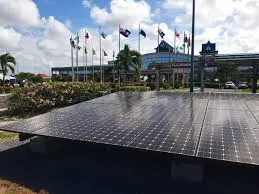
A living example of regional renewable energy goals is the Solar Photovoltaic Power Generation Plant on the foregrounds of the CARICOM Secretariat. The plant, funded through a grant agreement between the governments of Japan and Guyana to the tune of US$17.8M, US$7M of which were earmarked for the project, is a 400-kilowatt solar PV system with more than 1,500 panels, battery storage and an advanced Building Energy Management System which was installed to power the Secretariat building primarily from solar energy rather than grid-supplied electricity. It is expected to generate nearly all its electricity from solar on most operating days, dramatically reducing dependence on fossil-fuel-based grid power. Explicitly linked to the CARICOM Energy Policy, the generation plant was handed over to the Secretariat on 11 January 2022. It was designed to demonstrate how buildings and institutions throughout CARICOM can transition to renewable energy, serving as a model for both public and private stakeholders. The project also serves an educational and capacity-building purpose. For example, university students have toured the solar plant as part of CARICOM Energy Month activities, exposing future engineers and energy professionals to renewable technologies and how they support regional sustainability goals. This educational use connects directly to CARICOM’s regional strategy to build local human and institutional capacity, a policy priority in the renewable energy framework.
Electric mobility and cleaner transport are also increasingly integrated into the regional energy agenda:
• CARICOM and the Energy Programme have been accelerating electric mobility efforts, advancing awareness, guidance, and regional strategies to support electric vehicle (EV) adoption across Member States.
• Discussions at high-level energy forums and through CARICOM Energy Month activities, focus on electric mobility strategies aimed at reducing petroleum use in the transportation sector and encouraging fuel switching to cleaner energy sources.
A dedicated Regional Electric Vehicle Strategy (REVS) framework was developed to catalyse EV deployment across different types of transportation systems and to address barriers such as infrastructure, financing, and public acceptance.

To accelerate the transition to sustainable and renewable energy sources
Energy Security and Climate Resilience