Ambassador Dr. Kurleigh King
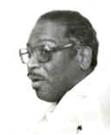
The time has come to pull many strands in this paper together in
order to form a good appreciation of where the Caribbean Community stood
when Dr. Kurleigh King became its Secretary-General. It will be
recalled that the high hopes of the Community had been dampened by the
effects of the global recession triggered by the increases in the price
of petroleum products in the late 70s. It will be recalled too that the
consequences of these increases for the Member States of the Community
were quite severe and led to decisions and actions which exacerbated
personal relations among leaders, changed the balance of forces within
the Community and had a negative impact on the progress of intra
Regional trade.
Moreover, most of the Member States were heavily
indebted at this time. Additionally, many observers and scholars in the
Region, among others, predicted the demise of the Community. One
particular consequence of this entire situation was the fact that the
Community had ceased meeting at the Heads of Government level. Also,
after the departure of Sir Alister McIntyre, a Secretary-General was not
appointed for more than approximately one year. And then, there was the
phenomenon of the increasing attrition of the levels of staff within
the Secretariat.
In the meantime, the ideological differences
among Member States of the Community had intensified. The mechanism of
ideological pluralism did not lessen tensions among Member States or
lead to a softening of attitudes. Indeed, at the first Summit which Dr.
King attended in his capacity as Secretary-General at Ocho Rios in 1982,
the ideological differences of the Member States of the Caribbean
Community were as clear as they were sharp. These were the circumstances
in which the Community set about the task of appointing a successor to
Alister McIntyre.
No decision on the appointment of a new
Secretary-General could be taken because, as pointed out earlier, the
Heads of Government were not meeting. An additional difficulty was that
the person holding the position of Deputy Secretary-General, Mr. Joseph
Tyndall, a Guyanese, could not be elevated to the position of
Secretary-General because there was a gentleman's agreement, that as
Guyana was the seat of the Community, it could not hold this position.
But this was a situation that could not be sustained, as it could only
lead to permanent damage to the integration movement itself and the
Secretariat. Pressure grew for the appointment of a Secretary-General.
By
a round-robin process therefore, the Heads agreed that Dr. Kurleigh
King should be appointed Secretary-General with effect from November
1978. He had in fact inherited the mantle of leadership of the
Secretariat at a most difficult period. The current Secretary-General,
Mr. Edwin Carrington, has observed that "no one but a king was willing
to risk what seemed to be a virtual professional death trap".20 At this
point of its existence the Community opted for a person with skills in
management. The reason for this decision might have been that the
Leaders of the Community had recognised that it had entered a different
and decisive period.
The Secretary-Generalships of Mr. Demas and
Mr. McIntyre essentially embodied the visionary aspects of the great
Leaders of the integration movement. The departure of Mr. Demas and Sir
Alister McIntyre within a period of eight years necessitated a period of
building and stability. This became even more urgent with the impact of
the economic crisis on the Community and the Secretariat and the
attrition in levels of staffing, as already indicated. As is the case in
most institutions and societies, the great visionaries are often
succeeded by the type of person, who would find it congenial to adjust
to the requirements of pragmatism and stability.
But Dr. King was
not daunted by the task before him. First of all, he had to repair the
consequences of the Secretariat being almost a year without a
substantive head. Resulting from this situation, some twenty vacancies
had to be filled. This he proceeded to do with great vigour. Not very
long afterwards, the Secretariat was functioning with some degree of
success. Qualified and experienced in management, Dr. King brought all
of his skills to bear and, indeed, he succeeded in creating a culture of
management within the Secretariat. His managerial skills were partly
honed during his period of employment at the Caribbean Development Bank
(CDB).
Dr. King placed emphasis on the use of computers and
generally brought organisational rectitude to the work of the
Secretariat. Senior and middle managers were exposed to the concepts and
techniques of modern management. Training became an integral part of
the activities and work of the Secretariat. The personnel and human
resource element of the Secretariat's work were also improved. And
generally, Dr. King undertook the overhaul and modernisation of the
working methods of the Secretariat. A former employee has observed:
"That the Secretariat was able to maintain its operations throughout
those most difficult times, and without any noticeable degradation of
its standards is a tribute to the leadership and understanding he (Dr.
King) provided during a difficult period".21
In his closing
address at the 3rd Meeting of the Heads of Government Conference of the
Caribbean Community on 3rd November, 1982, Dr. King pointed out that he
and the staff of the Secretariat were guardians of the integration
movement: "We consider ourselves to be the guardians of the integration
movement. When you have forgotten sometimes because of pressing national
problems, we always remember and I can assure you that the staff of the
Secretariat, whether I am there or not, will always place integration
first, because we do believe that the formal integration mechanisms that
we have set up are deeply based in the oneness, the oneness of the
Caribbean people."
Having attended to the problems of the
Secretariat, Dr. King turned his attention to one of the critical issues
of the Community: the inability of the Leaders to meet. And he so
managed the diplomacy behind the scenes, and, with the support of
important players, including some Heads of Government and committed
integrationists of the Region, he was able to gain agreement for the
first meeting of the Heads of Government of the Caribbean Community in
Ocho Rios in 1982 - the first such meeting in seven years. It was at
this meeting that it was agreed that there would be annual meetings of
the Heads. The Community has met with great regularity since then, and
this must be a testimony to the influential legacy left behind by Dr.
King.
It was a good and necessary development that the Heads had
been persuaded to meet on an annual basis, for the Regional
developmental agenda had considerably increased. The Region, as already
indicated, was grappling with major economic problems while at the same
time, in the external realm of international relations and politics,
great forces were gathering which would test the capacity of the Region
to survive. The Heads were able to generate ideas for the survival of
the Community, overcome the forces which were threatening to overwhelm
it, design programmes for economic adjustment and stabilisation, and
launched the Community on a new path.
Related Stories
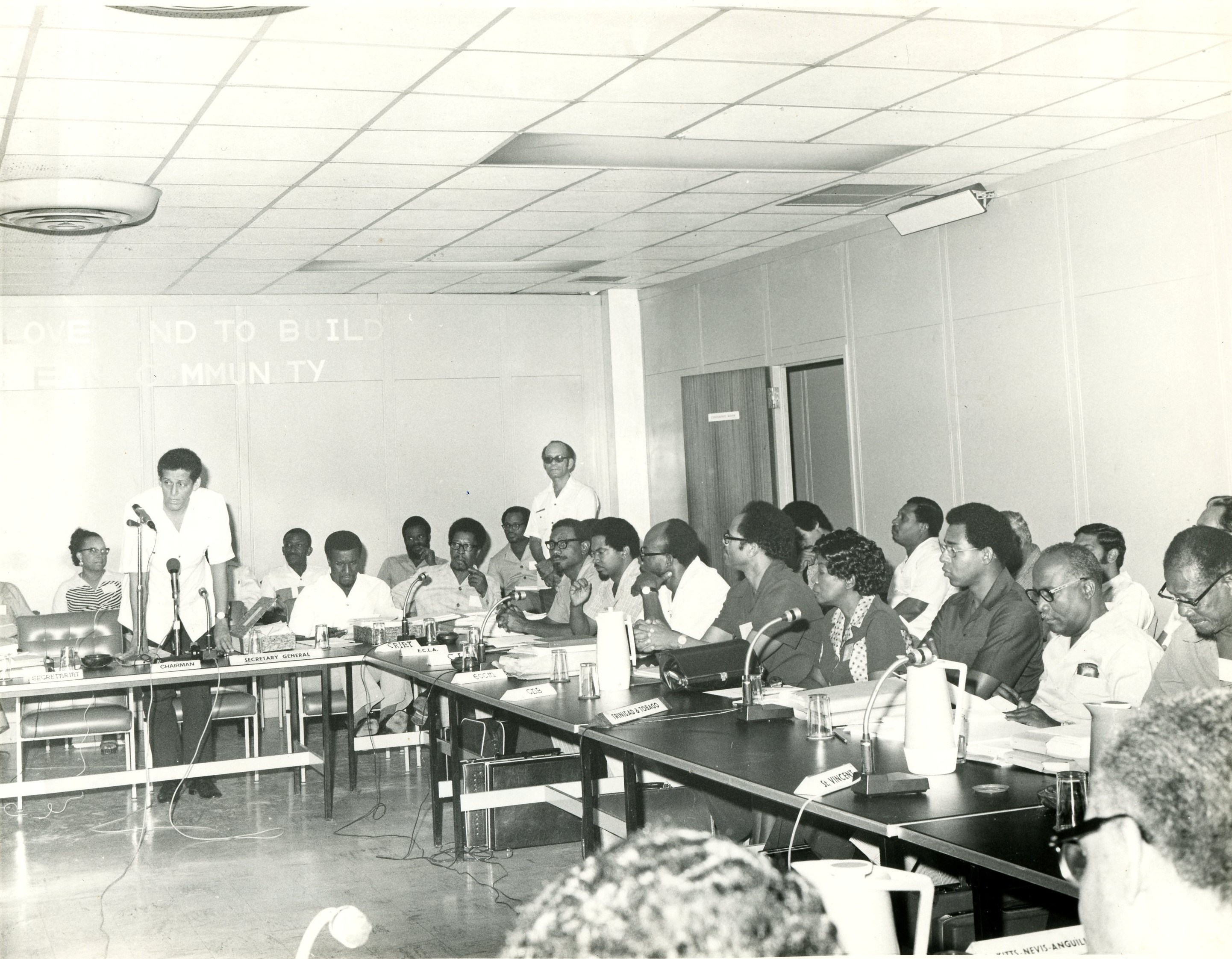
Lauding Grenada’s rich history in regional integration
Grenada will continue its historically prominent role at the forefront of regional integration when it hosts the 38th R
Lauding Grenada’s rich history in regional integration
Grenada will continue its historically prominent role at the forefront of regional integration when it hosts the 38th R