Tracking COVID-19 Pandemic in CARICOM

The outbreak of the COVId-19 disease was identified in Wuhan, China, in December 2019, with the earliest known case with symptoms being revealed on 1 December 2019. It was later declared as a Public Health Emergency by the World Health Organization on 30 January 2020, and, subsequently, as a pandemic on 11 March 2020. As of 24 April 2020, close to three million cases of COVID-19 have been reported, about 190,000 deaths and more than 750,000 recoveries over approximately 185 countries. In the United States of America which is now the epicentre of the disease, there are close to one million confirmed cases, approximately 50,000 deaths and 50,000 recoveries.
In the case the Caribbean Community (CARICOM), the first known confirmed case was in Jamaica on 10 March, followed by Guyana a day later, which was also the country and the date of first death from COVID-19 in the Region and the same case that was confirmed.

Tracing the COVID-19 and eventually coming up with therapeutic
applications for its treatment and vaccines for prevention are not
possible without science, including statistics.
Reliance on Statistics as a Science in tracking the Pandemic
Statistics as a science is grounded in probability and Mathematics,
which enables users to make decisions in the face of uncertainty. It has
implications for the use of random approach to data collection and
estimation, which is particularly significant given the need to
effectively monitor the infection rate of the virus. While the more
visible aspects of this science are the collection, organisation,
presentation, analysis and interpretation of numerical data, the less
well-known aspects of this science include use of probability theory in
data collection, estimation and analysis. The COVID-19 is a Novel virus which
is a virus that has not been previously identified. There is a lot to
learn about it and hence the importance of data gathering and analysis
of its mode of transmission, symptoms experienced, impact on varying
population groups, response to interventions and treatments.
Data Availability in CARICOM and its Quality
Data on the Region are available from a number of sources nationally,
regionally and internationally. Essentially, the primary source of the
data is national and is based on administrative data. At the national
level, the Ministries of Health are the main agencies that are
monitoring the number of confirmed cases, with a cumulative total
produced on a daily basis; the number of new cases, which, as the name
applies, is the change in the number of confirmed cases from the
previous day to the current day; and the number of deaths, which is a
cumulative total. In addition, most countries are now monitoring the
number of recoveries. For some CARICOM countries, there is also limited
information on mode of transmission – imported, locally transmitted,
community transmitted, not epidemiologically linked to any confirmed
case and under investigation. There is also limited information on sex
and by hospitalisations, and by the number tested. Data are also
available by geographic area within countries.
The trend in the number of confirmed cases tells us about the
infection rate of the virus in a specific country. The new cases reflect
the rate of transmission of the virus daily and by extension over a
period of time. The approach to combatting the virus is to keep the new
cases at zero level, that is to reduce the spread of the virus down to
zero, particularly the local and community spread during the closure of
the borders of countries. Finally, apart from the critical issue of no
new cases, the other ideal outcomes will be no deaths and recovery of
all active cases from the virus.
The quality of data and consistency and completeness of collection
are able to ensure that tracking and overcoming the pandemic are
successful. The data as reported by countries have a number of
limitations that often show up in the various data hubs that disseminate
national level data. Firstly, there is often a lag in reporting of the
data, such that the figures as reported in any one day, do not reflect
the current day cumulative number of confirmed cases and deaths and also
the number of new cases. Some countries do not routinely report the
data on a daily basis; they may combine results for more than a day, or
data for the past periods. There is also the issue as to when the actual
case was confirmed or death occurred and the date it was reported which
may imply inaccuracies in the daily figures. Sometimes countries may
not report on weekends or on a specific day with the result that the
subsequent report is a combined report for two days that makes it
impossible to do the daily tracking of the new cases and confirmed
cases. For regional and international data hubs, these challenges are
reflected through inaccurate cumulative total confirmed cases and deaths
on specific days and therefore errors in the number of new cases.
What do the Statistics tell us about the Trajectory of the Pandemic in CARICOM?
From the first case in the Region on 10 March, there were
approximately 334 confirmed cases at the end of that month, and at 24
April, just about one week before the end of the month, the Region stood
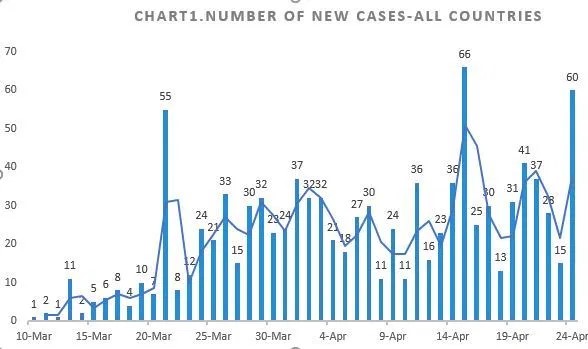
at 1 034 confirmed cases of the virus. During March, there was a spike
in new cases. On 21 March, 40 of the 55 new cases were cruise ship
passengers who had returned to Trinidad and Tobago. This also led to a
sharp increase in the number of confirmed cases for that country to 49,
an addition of 40 new cases, as well as the predominance of imported
transmission as the main mode for transmitting the virus. Other major
spikes in new cases for that month were on 26 March (33 confirmed cases)
and 29 March (32 cases). For the month of April, the spikes in the
number of new cases have occurred on 15 April (66), 24 April (60), 20
April (41) 1 April and 21 April (with 37 new cases each) and several
other days that had a number of new cases over 30. In effect, compared
with the period 10-31 March (21days) that contributed 334 confirmed
cases, the period 1-24 April saw an additional 700 cases over 24 days,
which shows a definite uptick in the spread of the virus.
Viruses, including the COVID-19 infections, tend to grow
exponentially. Fixed rate exponential growth implies that the number of
cases doubles over a defined period of time. Monitoring of the doubling
time in days can indicate the rate of spread of the virus, subject, of
course, to limitations in coverage of cases. If the doubling period in
days is short, it represents faster growth of the virus compared to a
longer doubling period. The doubling time is dynamic and informs on the
impact (or lack of impact) of interventions on epidemic growth, all
things being equal.
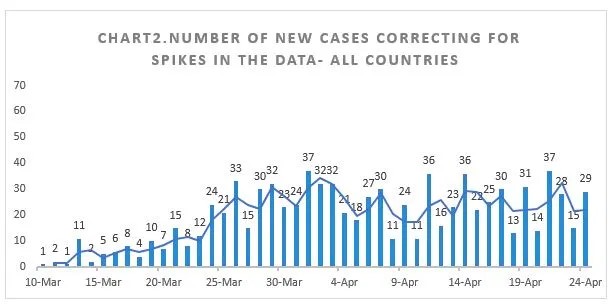
In the case of CARICOM, despite the high number of new cases in absolute terms, the doubling rates over time exhibited for the CARICOM total number of confirmed cases are five days -21-26 March, eight days (26 March – 3 April), 12 days (29 March – 10 April) 15 days (2 – 17 April). The fact that the number of days doubling rate is increasing shows essentially a lowering of the infection rate overall for all countries. However, there is need to perhaps see whether there are a few countries that are contributing to the large absolute increase. Before this issue is addressed, a closer look at the trend-line of Chart 1 shows a general increasing pattern in the period 25 March-4 April, and another increasing pattern, followed by a declining pattern around the 9-14 April, and ending with an increasing trend 18-24 April. If one were to remove the spikes in the data, the pattern, as in Chart 2 will show a generally flatter pattern using the same scale as in Chart 1.
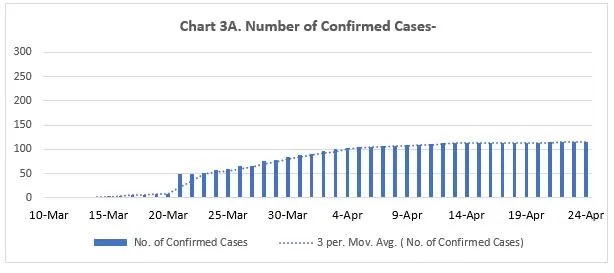
Generally, it would appear that except for about four or five countries that seem to be experiencing an increasing trend in transmission, the remaining countries, up to the period 24 April, appear to have a fairly low rate of transmission as reflected in the new cases – essentially the changes in the number of confirmed cases over time. As an example, two graphs are presented for countries that, on the one hand, seem to have little or no transmission (Chart 3A), and another that appears to have an increasing trend (Chart 3B) based on the number of confirmed cases. In both cases the scale and the starting date are uniform.

Tracking of the COVID-19 virus and monitoring the impact of the
interventions aimed at containment are possible through collection and
presentation of the statistics on new cases, confirmed cases. The impact
of the severity of the virus is also monitored using deaths as well as
hospitalisation and recovery rates.
In order to compare the situation across countries, it is necessary
to adjust for population size. The recommendation is to use rates per
100,000 (see Explanatory Note in Issue 3).
For example, in the case of deaths, one death in a very small country
when adjusted for per 100,000 population, may reflect 20 deaths, while
for a larger country, one death might be half of that rate, 10 deaths
per 100,000 population.
Governments’ Response the Role of Communication and added Science
Notwithstanding the interventions of governments, in the use of
social distancing that leads to an almost complete economic shutdown of
countries, these interventions must also be balanced with the science of
statistics through the use of a random approach to the testing of
individuals. To date accessibility to get tested have followed set
criteria or protocols, that were amended slightly when countries
effectively closed their borders. These protocols included: a history of
recent travel, fever, persistent cough and shortness of breath. This
approach was also grounded in the availability of reagents and other
equipment to do the testing. It therefore did not follow a random
approach which would enable an estimation of the true value of persons
that have the virus. The issue of a random sample is grounded in
probability theory one of the key bases of statistics. This issue is of
significance given that the virus is novel and, as it turned out, there
are instances the world over where persons are either asymptomatic or
experience very mild symptoms that do not require
testing/hospitalisation.
Therefore, testing and random and a continuous testing strategy
should factor in the strategy of governments to arrive at the total
number of cases, to enable the tracing of all contacts, and to treat
with the varied and unknown characteristics about the virus.
The application of statistics in this entire process cannot be underestimated.
You may also be interested in:

Mensaje de fin de año de la Secretaria General de la Comunidad del Caribe (CARICOM), Dra. Carla N. Barnett
We have come to the end of another year during which strenuous efforts have been made to ensure that the integration process improves the lives of the people of the Caribbean C
La CSME, la seguridad alimentaria y la financiación climática encabezan la agenda de la Cumbre de CARICOM en las Bahamas.
The CARICOM Single Market and Economy (CSME); food security; climate change and climate finance; health; and security will be among the major topics when Heads of Government of
La Secretaría de CARICOM y la Agencia Caribeña para Soluciones de Justicia (CAJS) forjan una alianza para acelerar la transformación digital.
La Secretaría de CARICOM (CCS) y la Agencia Caribeña para Soluciones de Justicia (CAJS) han establecido una importante alianza con el objetivo de impulsar la transformación digital y mejorar la preRelated Stories
Stats News and Views
The Special Topic Statistical Bulletin on COVID-19 in CARICOM Countries Issue 31, provides an update of the trajectory of the COVID-19 in the CARICOM Region up to 23 October 20
CARICOM Covid-19 Response Agri-Food Plan
The Caribbean Community is committed to reducing its food import bill by at least 25% over the next five years. So says Mr.