Pushing the Caribbean agenda in Paris
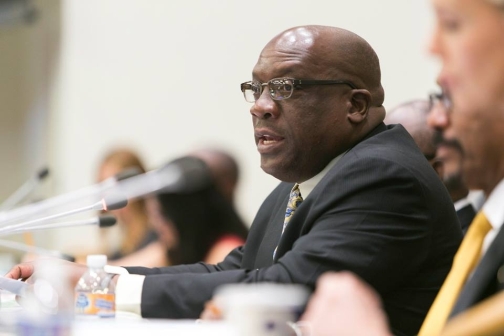
St Kitts-Nevis PM makes impassioned plea at climate change conference
PARIS, France (CMC) – St Kitts-Nevis Prime Minister Dr Timothy Harris has called on the international community to “negotiate and agree a legally-binding agreement with ambitious emission reduction targets”.
Addressing the 21st Conference of the Parties of the UN Framework Convention on Climate Change (UNFCCC), Harris reiterated the seriousness and urgency of the threat posed by climate change and the need for an ambitious agreement to be reached during the two week conference.
“My delegation calls on all parties here to negotiate and agree a legally-binding agreement with ambitious emission reduction targets. St Kitts and Nevis recommends that all parties subscribe to at least five-year commitment cycles with robust ex-ante review and ex-poste assessment processes.
“We also hope that developed country parties and other parties in a position to do so, would be encouraged to provide support to vulnerable countries, particularly to Small Island Developing States (SIDS).”
He told the conference which is being attended by more than 100 world leaders that his twin island Federation, like other SIDS “has been undergoing many climate related changes; namely sea level rise, extreme weather events, prolonged and severe droughts, and disruption to our reefs, coastlines and agriculture”
Harris said that the dangers of climate change are real and present and that the threat is also existential. He said greenhouse gas emissions from small island states like St Kitts and Nevis are negligible “yet our small island states continue to be adversely and disproportionately affected by the impacts of climate change.
“Nonetheless, as responsible global citizens, we in St Kitts and Nevis are already acting locally to reduce our national carbon footprint even further. The pursuit of renewable energy solutions is now a critical and integral component of our national sustainable development strategy to transform St. Kitts and Nevis into a fully environmentally sustainable small island state.”
Harris said that hi new administration “is incentivizing behavioural changes through the facilitation of duty free concessions on renewable energy technologies.
“We are building strategic partnerships with countries and the private sector to develop geothermal, solar and wind energy solutions. Currently, we have solar farms operating on both St. Kitts and Nevis and are also exploring the potential geothermal capacity on the islands. These renewables will have a significant impact on our energy consumption patterns and reliance on fossil fuels.”
You may also be interested in:
Stakeholders Engage in Consultations to Strengthen National Youth Policy
The Department of Youth Development and Sports, through its Youth Unit, has commenced a four-day series of half-day closed stakeholder consultations aimed at strengthening the development and...
Regional Workshop Strengthens Caribbean Capacity on Genetic Resources
Regional policymakers, scientists, and biodiversity experts gathered from March 3-5, 2026, at The University of the West Indies (UWI), St.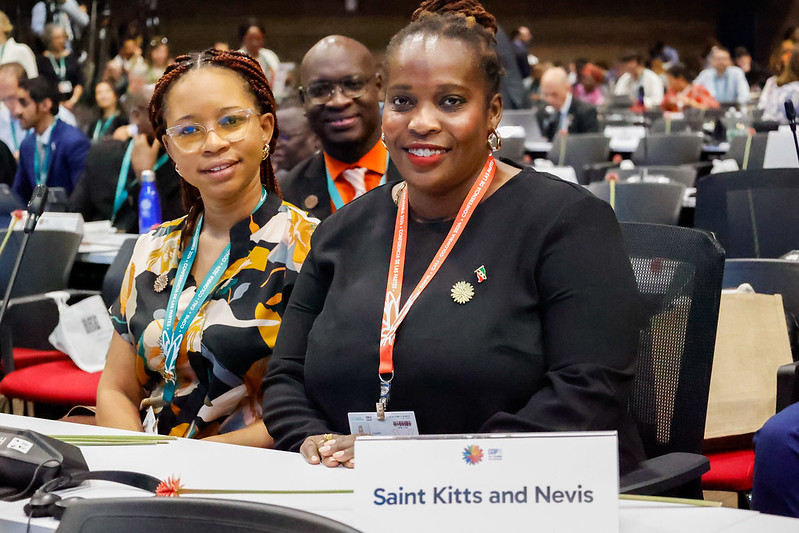
Statement by Hon. Dr. Joyelle Clarke, Minister of Sustainable Development, Environment, Climate Action and Constituency Empowerment of Saint Kitts and Nevis| High-Level Segment, 16th Meeting of the Conference of Parties of the UN Convention on Biological Diversity| Cali, Colombia| 30 October 2024
"The fight for biodiversity cannot be disentangled from the climate crisis. This is why our commitment to the Kunming-Montreal Biodiversity Framework is especially critical and why Saint KittsRelated Stories
CARICOM Ministers see COP28 as a test of the world’s commitment to the most vulnerable
MINISTERIAL STATEMENT COP28 is a milestone for the climate agenda.
Statement by Dr Carla N Barnett, Secretary-General of the Caribbean Community (CARICOM), following the 27th Conference of the Parties to the United Nations Framework Convention on Climate Change (COP27)
One week after the end of COP27, it is clear that the outcomes are mixed.