Out of a rendezvous in the tourist atmosphere of Paradise Beach, Bar-bados, eight years ago this month. was spawned an idea that culminates in the launching on August 1 next of a Caribbean Community with a Common Market
Two West Indian Prime Ministers were at that rendezvous-Guyana’s Forbes Burn- ham and his Barbadian counterpart Errol Barrow. And they emerged with a decision that now the first effort at West Indian political unity was part of our history of failures, a new initiative was required to promote regional economie co-operation. The Instrument they recommended as a first but effective step towards this co-operation came to be known by December 1965-when Antigua’s then Prender Vere Bird, teamed up with Burnham and Barrow to sign an agreement at Dickenson Bay-as the Caribbean Free Trade Association (Carifta)
In the region where the isolationist polities, narrow chauvinism, personality conflicts, political jealousies and suspicions helped in wrecking the British-conceived West Indies Federation, the political trio who gave birth to Carifta were to discover that their colleagues did not favour the idea of being surprised by their move towards regional and economic cooperation.
WEIGHING THE ADVANTAGE
But what was the alternative?
Mr. Burnham, whose country as colonial British Guiana, was not part of the Federation, and which country is regarded as bounding in more natural resources than any of the ten islands that were part of the Federation, had declared that either Guyana and the scattered island territories of the Caribbean swim together, or drown en their own.
To the Prime Minister, of Trinidad and Tobago, Dr. Erie Williams, who, some years earlier, in 1903, had organised the first Caribbean Heads of Government Conference, Mr. Burnham was taking an obviously pragmatic view of the choice facing the region. But conscious of his own domestic political problems, he decided to play for t me before allowing Trinidad and Tobago to accede to membership of Carifta.
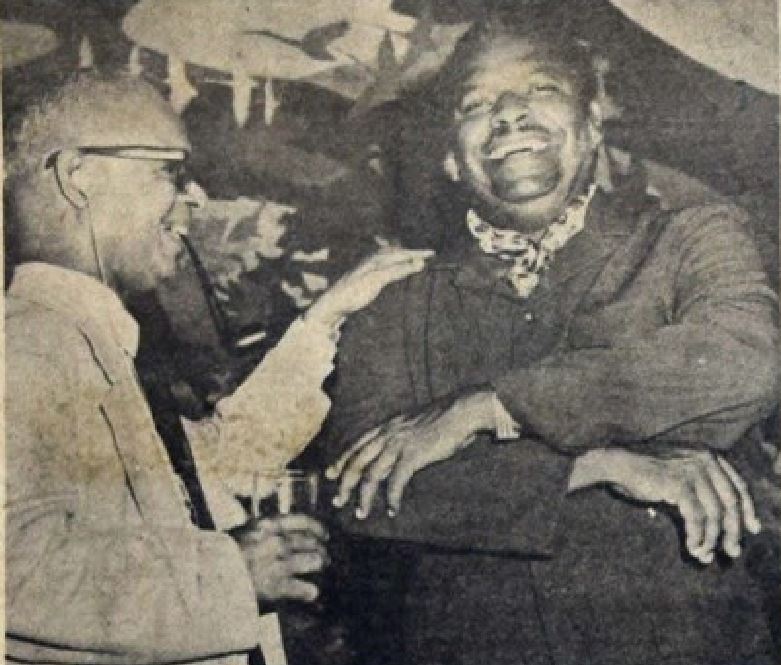
In Jamaica, where the sentiments for regional political and economic unity were never strong, and where the party which was responsible for that island to be out of the Federation by 19xx -the Jamaica Labour Party-was in office, it was a question of weighing the advantages for Jamaica, even before welcoming the free trade idea. THE COMMUNITY DR. WILLIAMS and MR. BARROW in a happy mood.
A SIGNIFICANT DEVELOPMENT
The small islands of the Leeward- Windward Group, having been forsaken by even Barbados-which was to have been the principal partner in a proposed federation of the Little Eight that never materialised -were by then more preoccupied with the idea of resolving their own constitutional status with Britain than to bother with this Carifta thing.
But patience and understanding led eventually to the Dickenson Bay Agreement of 1965 becoming the blueprint for the launching of a free trade area which became effective on May 1, 1968, and involving Guyana and all of the English-speaking Caribbean countries, with the exception of the Bahamas, Belize and Bermuda.
The seven Associated States and Montserrat of the Eastern Caribbean delayed their accession to membership of Carifta until the creation of a Common Market among themselves within the free trade area in July 1968.
With Belize’s subsequent accession to Carifta, this free trade club, involving an area of some 100,000 square miles, and nearly five million people, was to provide the frame-work for the deepening of the regional integration movement.
From the very beginning, however, it was evident that the road towards an economic community would be a tortuous one, made difficult by suspicions that Guyana was out to revive the idea of political unity with hopes of leading a new political union,
INCREASING THE FLOW
HE material for the supplement “Inside the Caribbean Community” was collected by two of the region’s leading journalists Raoul Pantin of Trinidad and Rickey Singh of Guyana, The exercise was conceived by the UNDP. UNESCO Mass Communications team in the Caribbean, which among other things is concerned about increasing the flow and exchange of information among the countries of the region. The UNDP-UNESCO project engaged the two journalists who visited most of the countries of the region, and held dis- PAGE 2 people cussions with from all walks of life as well as officials of government. able to all radio stations throughout the area. The team’s work in the Caribbean is primarily concerned with assisting the region in starting a Department of Communications at the Univer- sity of the West Indies, The UNDP-UNESCO team is also assisting Trinidad Television, the Jamaica and Tobago Broadcasting Corpora- tion and the Caribbean the Caribbean News Broadcasting Corporation Agency, and strengthen- in Barbados, in the pro ing existing communicaduction of a 40-minute tions institutions through- feature film on the Carib- out the area. bean Community, which will also be made avail- able to those countries without television. It is further planned to produce a number of sound-radio documenta- ries on the Community, again to be made avail- The project also assists governments and vari- ous development agen- cies throughout the area in ensuring that communications plays a greater role in the cultural, development of economic. social and the are and that Jamaica and Trinidad-the most industrialised Carta qountries, wh the branch plants of the multi-national corpora tions-would dominate the Carifta market, relegating the small islands to the role of mere purchasers of regional manufac tured goods. If the disequilibrium in trading patterns were to become a factor of conflict in the years that followed the launching of Carifta -especially in the absence of tangible economie gains for the small islands of the Eastern Caribbean-then what proved even more frustrating for some of the member terr ‘tories, and Guyana in particular, was the failure to co-ordinate and carry out deci- sions other than those designed to expand inter-regional trade. Even before the launching of Carifta in 1968, there was the failure by the inde- pendent Car fta countries Jamaica, Guyana, Barbados and Trinidad and Tobago-to jo’ntly implement a programme they had discussed and formulated to restore Anguilla to the fold of its sister islands of St. Kitts- Nevis, from which it had seceded in 1967. STILL GATHERING DUST Anguilla, totally frustrated by its poverty, a legacy of British colonialism is today still a secessionist colony, and this, in spite of all the rhetoric against the colonialists divide- and-rule policy and the continued metro- poli’an presence in the region. The report presented by the ex-Chief Justice of Trinidad and Tobago, Sir Hugh Wooding, on the Anguilla problem and the allusions made in relation to the danger of other Anguillas in the region, is still gather- ing dust on the shelves of the Carita Governments. And this, even now when, once again inspired by interests outside of the Caribbean the people of Abaco in the Bahamas are threaten ng secession, rather than be part of the Commonwealth of the Bahamas which becomes an independent territory on July this Another frustrating experience, time after Carifta, was the retreat from political unity-the failure by the West Ind’an Governments to go ahead with the Grenada Declaration of November 1, 1971. This helped to dramatise the deep distrust that still characterises relationships ameng, the Carifta countries, and, to the chagrin of those committed to a new West Indian nation, contributes to the feeling among European, that decendants of slaves and indenture immigrants in the West Indies are not to be taken seriously. As it is now in the case of Montserrat, vis-a-vis, the Caribbean Community, so was the feeling in 1971 that external influences had helped to destroy before it got off the ground, the Grenada Declaration for poli- tical unity, There are others, however, who, making a more studied analysis of the prevalling situation, advance the argument that more than the possible involvement of external influences, was the crisis of confidence that existed particularly in the small island terr tories which had signed that Declaration. In the scramble of party politics in these island territories of the West Indies, as indeed it is the case in Guyana on the South American mainland. there exists a basic lack of confidence between ruling and opposition parties and between parties and the people. Where social problems of inadequate housing, education and medical facilities, and a burgeoning unemployment, ranging from 12 to 20 per cent, contribute to the crisis of confidence in the region, it was not surprising to find that those who had renegned on their signatures to the Grenadian Declaration, were worried by the united stand shown by the pallamentary opposition parties who actually arranged a conference in Dominica to denounce the Grenada Declara t’on, warning, that the people were being taken for a ride. But while both governing and parlia mentary opposition parties keep alive the dialogue about regional unity, speaking always in the name of the people, the experience has been that serious and genuine attempts are still to be made to explain to the masses the meaning of the decisions taken and the mechanisms being employed to real se a better life for them through reg’onal economic and political integration. FAILURE TO COMMUNICATE William Demas of the Caribbean Regional Secretariat, in emphasising the great need to involve the people in all aspects of the integration programme, found t necessary to point out, even after the sign- ing of the Georgetown Accord in April last, that “if the public knew more about the Issues involved ‘s the defunct Federation, it would have survived.” And Demas further stated that an area of great weakness in the whole regional Integration movement over the past five years of Carifta has been the failure to communi- cate with the public. In this respect it is of significance to observe that not one of the region’s govern ments has so far taken to the street corners to explain to the public the ram’fications of transforming Carifta Into a Caribbean Community, of what basically this would mean to the people in whose name they have acted. Debates on the significance of the decl s’ons taken at the 1972 Caribbean Summ’t at Chaguaramas and the Genreetown Caribbean Summit of April 1973, have largely been restricted to the cut-and-thrust of parliamentary dialogues with ruling and epposition parties being more preoccup’ed with scoring debating points, foresaking information In preference for platitudes and n or abuse. The Guyanese Foreign Minister, Mr. S. S. Ramphal, has, nevertheless, hailed the establishment of the Caribbean Community as “the most significant development in the Caribbean since the Cuban Revolution,” some 14 years ago. In sp’te of the disappointments which even now are evident by the factor of two separate timetables for the Carifta member countries to all become members of the Community by May 1, 1974, Mr. Ramphal may be right. But even Mr. Ramphal will, however, agree that there are others both within and outside of the region’s political arena who may question the accuracy of his interpre tation of this historic development from Carifta to Caribbean Community. But who will deny the significance, of the remarkable journey, over eight years, from the Burnham-Barrow meeting on Paradise Beach to the signing of the Caribbean Community Treaty at Chagua- ramas. Meeting of Carifts Council of Ministers in Georgetown, 1970. Second from left is Mr. Erie Murray, Trinidad and Tobago High Commissioner in Guyana, and next to him is Mr Edward Braithwaite, Petrmanentary Secretary, Ministry of Industry and Com- merce. CARIBBEAN COMMUN TY TREATY CONFERENCE SUPPLEMENT, July 1, 1972
Related News

NATURAL DISASTER IMPACT MITIGATION: STRENGTHENING NATURAL DISASTER WARNING SYSTEMS ACROSS VULNERABLE...
The tremendous loss of life and destruction caused by the earthquake and tsunami in the Indian Ocean region on 26 December 2004 have shocked the world at large and shattered the lives of many…
 admin
admin

CARICOM Secretariat, IMPACS webinar focuses on ‘Youth as Agents for Change in Crime Prevention’
‘Youth as Agents for Change in Crime Prevention’ will be the focus of a webinar that the Caribbean Community (CARICOM) Secretariat and the CARICOM Implementation Agency for Cr

Nominations open for CARICOM Energy Awards 2025
Caribbean Community (CARICOM) Citizens and residents are invited to apply for or nominate a peer, mentor, or mentee for the CARICOM Women in Sustainable Energy Awards (WISE),