CARICOM Secretariat launches solar project for Headquarter's Building
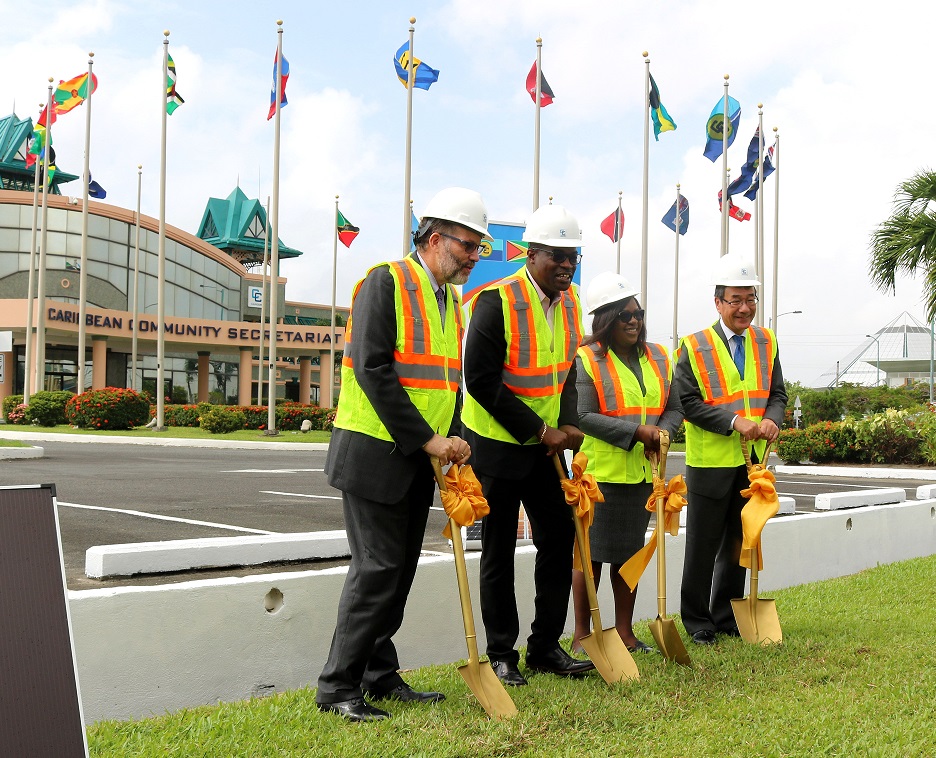
Turning the sod (from left) Secretary-General Ambassador Irwin LaRocque; Minister of Public Infrastructure, Guyana, Hon David Patterson; Minister of Foreign Affairs, Guyana, Dr. Hon. Karen Cummings; Japan’s Ambassador to CARICOM and Guyana H.E. Mr. Tatsuo HIRAYAMA
A project that will see the CARICOM Secretariat’s Headquarters Building in Georgetown, Guyana generating 100 percent of its electricity needs through a Photovoltaic Power Generation System was launched with a sod-turning ceremony on Monday.
The Project, being funded by the Government of Japan, will include:
- Installation of 400 kilowatt of solar photovoltaic power generator to provide electricity to the Secretariat building;
- A battery and power conditioning system for energy storage and power quality regulation; and
- An advanced building energy management system to, among other things, provide air conditioning controls and track energy efficiency and indoor air quality.
The planning is being coordinated by the CARICOM Energy Committee chaired by Deputy Secretary-General Ambassador Manorma Soeknandan.

Today marks another milestone in the history of the CARICOM
Secretariat. Today marks another milestone in the relationship between
Japan and the Caribbean Community.
This is the beginning of the end of a journey which the DSG has
described and in which I was privileged to be engaged from the start,
although in another capacity.
I well recall the green buildings initiative and the first Energy
Audit of the Secretariat in 2010 which laid the initial groundwork for
the journey that has brought us here today pursuing energy efficiency.
It was an initiative fully supported by the Executive Management
of the Secretariat, who urged that our headquarters should be a green
building as an example to other public buildings in the Community.
Now with the help of the Government of Japan, we are on the way
to achieving that objective. It is most fitting that Japan is once
again involved in a Project, with respect to these premises, which it so
generously assisted in providing.
We are breaking ground today in front of our beautiful
Headquarters building which was built by the Government of Guyana, for
which we are eternally grateful, with considerable financial support
from the Government of Japan.
Apart from this Project and these premises, the Government of
Japan has supported a significant number of initiatives in disaster
management, climate resilience and sustainable energy in the Region.
On behalf of the Secretariat and the Community, I thank the
Government of Japan for their continued support and look forward to
strengthening the links to our mutual benefit.
I wish, as well, to express appreciation and gratitude to the
Japan International Cooperation Agency (JICA) for the financial and
technical support for this Project.
I must also thank the Government of Guyana for supporting the development of this Project.
Over the last decade, renewable energy and energy efficiency have
been on the forefront of the Region’s Agenda. This is because there is
global acknowledgement that the way in which we produce, deliver and use
energy is important to our sustainable development.
Globally, the building sector is the largest energy-consuming
sector, accounting for 42 per cent of electricity usage, and is equally a
major contributor to carbon dioxide emissions. Within CARICOM,
buildings account for nearly 80 per cent of electricity usage. This is,
in part, due to our climatic conditions, as well as design, with
buildings requiring significant amounts of cooling and humidity control.
The increasing attention to climate change and energy costs
within the Region has focussed attention on energy use in buildings.
The CARICOM Energy Policy, which was adopted in April 2013,
promotes efficient energy-use in buildings. This was an important driver
for the development of the CARICOM Energy Efficiency Building Code,
which was approved in April 2018.
The CARICOM Secretariat is demonstrating, through this Project,
that we are not constraining ourselves to only leading the policy and
strategy agenda, but that we are also practicing the principles that are
being promoted.
In closing I must give very special thanks to Deputy
Secretary-General Ambassador Manorma Soeknandan, who led the CARICOM
Secretariat Energy Committee, and whose work has brought us to this
moment and ensured the dream has become a reality.
I look forward to the completion of this Project which is truly a
symbol of the renewed energy in relations between CARICOM and Japan!
I thank you.
You may also be interested in:
End of Year Message from the Secretary-General of the Caribbean Community (CARICOM) Dr Carla N Barnett
We have come to the end of another year during which strenuous efforts have been made to ensure that the integration process improves the lives of the people of the Caribbean C
CSME, food security, climate finance top agenda of CARICOM Summit in The Bahamas
The CARICOM Single Market and Economy (CSME); food security; climate change and climate finance; health; and security will be among the major topics when Heads of Government of
CSME, food security, climate finance top agenda of CARICOM Summit in The Bahamas
The CARICOM Single Market and Economy (CSME); food security; climate change and climate finance; health; and security will be among the major topics when Heads of Government ofRelated Stories
CARICOM Secretariat and Caribbean Agency for Justice Solutions (CAJS) Forge Partnership to Accelerate Digital Transformation
The CARICOM Secretariat (CCS) and the Caribbean Agency for Justice Solutions (CAJS) have come together in a significant partnership aimed at advancing digital transformation an
CARICOM Secretariat and Caribbean Agency for Justice Solutions (CAJS) Forge Partnership to Accelerate Digital Transformation
The CARICOM Secretariat (CCS) and the Caribbean Agency for Justice Solutions (CAJS) have come together in a significant partnership aimed at advancing digital transformation an