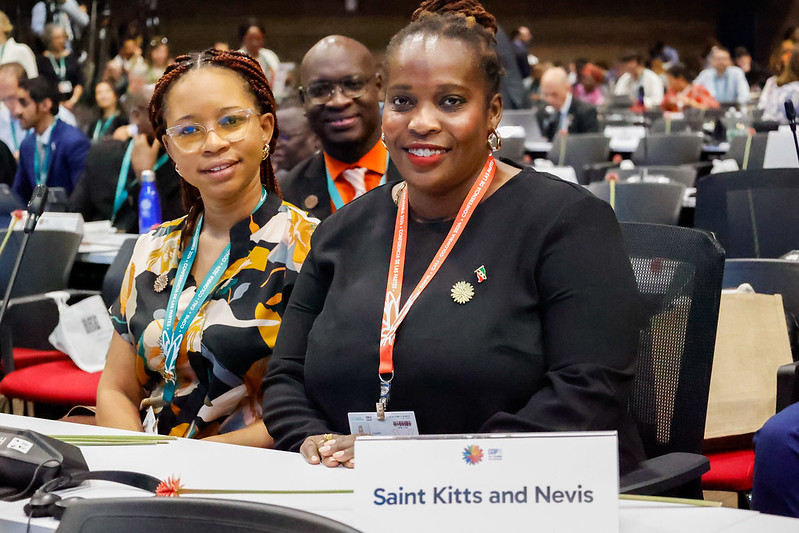
Big boost for region: Major EU funding could benefit key areas for Caribbean states
FOR the first time the European Union (EU) will be providing 1 billion euros in development aid to the region.
Word of this comes from Head of Delegation of the European Union to Barbados and the Eastern Caribbean, Ambassador Mikael Barfod, who was delivering welcome remarks at the second bi-regional policy dialogue, ‘Sustainable Bi-regional Multi-stakeholder Policy Dialogue on Science and Technology, which was held at the Cave Hill Campus yesterday.
His comments came as he revealed that the 11th European Development Fund (EDF) programme is being finalised. “This support will be focused in three areas. Regional integration, climate change and crime and security. These areas provide several prospects for the Science, Technology and Innovation Community and align well with the research agenda for the region.”
Ambassador Barfod in his address, observed some apparently counter-intuitive concepts in the region, which he noted could collectively effect a new paradigm.
Highlighting his observations over the past year and nine months in the region, he said. “Each country within the region contributes a significant portion of its annual budget on human resource development, but continues to suffer from human capacity constraints in several potential growth areas.
“Substantial sums are spent on higher education, including financing from the EU on development of community colleges across the region, but there is a poorly developed research culture, especially in science and technology.
“The private sector plays a critical role in the development to the economies of the region and in support of higher education, yet there appears to be a significant disconnect between scholarship and practise.”
Additionally, he noted that while institutions such as the EU have made available significant financing for research and development, research institutions appear challenged to access this financing.
It is against this backdrop that he suggested these apparent counterpoints converge with a single message. “Leaders in the region must identify sustainable, strategic, scalable solutions for translating investments in education and research into policy imperatives and innovative enterprises. Similarly we as development partners must create flexible and easily accessible funding options that facilitate the transition from thought to enterprise.”
The Head of the EU delegation opined that the outputs from EUCARINET programme between the EU and the Caribbean has provided an appropriate foundation on which this message may be actualised. “The formulation of the final policy brief and strategic plan for sustainability is an extremely useful product for establishing the research, development and cooperation going forward.”
He said that the EU’s seven year Horizon 2020 programme will help to rationalise the trust in the sector over the next few years. (JH)
You may also be interested in:
Stakeholders Engage in Consultations to Strengthen National Youth Policy
The Department of Youth Development and Sports, through its Youth Unit, has commenced a four-day series of half-day closed stakeholder consultations aimed at strengthening the development and...
Regional Workshop Strengthens Caribbean Capacity on Genetic Resources
Regional policymakers, scientists, and biodiversity experts gathered from March 3-5, 2026, at The University of the West Indies (UWI), St.