Antigua-Barbuda ambassador calls for reparatory justice from Harvard University
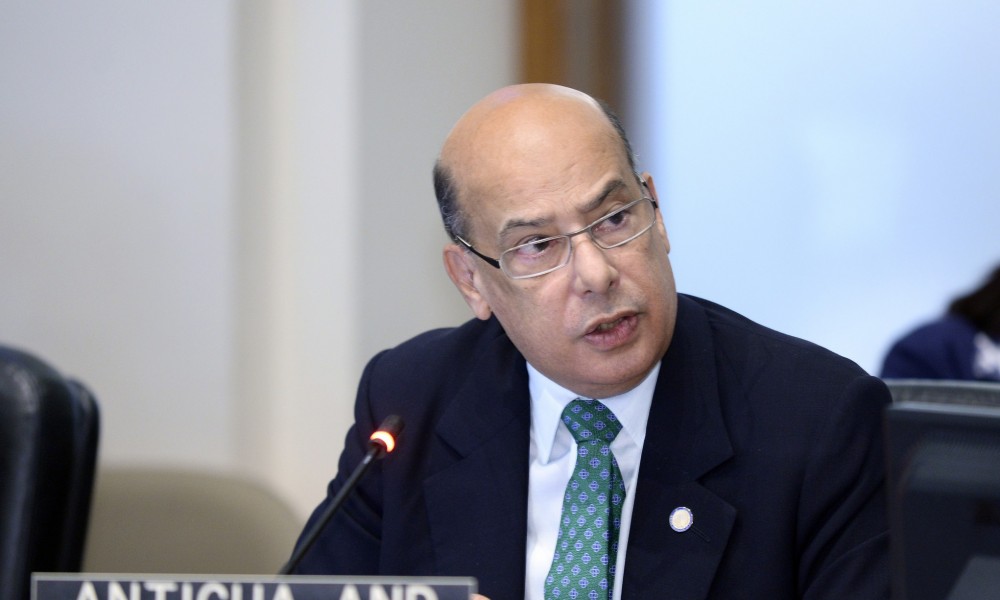
WASHINGTON, USA -- Antigua and Barbuda’s ambassador to the United States, Sir Ronald Sanders, has called on Harvard University “to demonstrate its remorse and its debt to unnamed slaves from Antigua and Barbuda” whose lives were abused to establish the Harvard Law School (HLS).
In a letter to Professor Drew Faust, president of Harvard University, Sanders recalled that the bequest of Isaac Royall Jr to Harvard College in 1781 that was used to create the first endowed professorship of law in 1815 came from the labour of human beings enslaved on Royall’s plantation in Antigua.
The ambassador said he was sure “that Harvard University, like all other institutions with a consciousness of right, has been inspired by the recent acknowledgment and atonement by Georgetown University for the sale of 272 human beings in 1838 to save the University from collapse”.
In this connection, he told the Harvard University president, “This is an excellent example for your university to follow, particularly since the founding of Harvard Law School was premised on the brutal, violent, oppressive and dehumanizing use and sale of men, women and children from Antigua and Barbuda.”
Specifically, Sanders proposed that “one tangible way in which the University and Harvard Law School should show remorse and repay its debt in a small way, while living up to the high ideals it proclaims, is to offer scholarships to Antiguans and Barbudans on an annual basis”.
He urged the university’s corporation to implement the proposal he put to them on behalf of the people of Antigua and Barbuda.
Isaac Royall Jr., in the words of one HLS professor, was “a brutal slaveholder”. He was born into a colonial-era family of wealthy Triangle Trade merchants and owned an estimated 60 slaves. At one point, Royall and his father brokered the sale of 121 human beings in one day. Another time, they had 77 slaves burned alive at the stake following a failed rebellion.
The oldest and arguably the most distinguished chair in American legal education is Harvard’s Royall Professorship of Law. Its distinction comes not from its age or its founder, but from those who have held it. These include distinguished figures in legal education but it is a historical fact that this chair is directly linked to a slave revolt on the island of Antigua in 1736.
The revolt had been carefully planned and involved about 2,000 slaves, many driven to desperation by starvation and thirst from terrible droughts. Like most Antiguan slaveholders, the Royalls grew sugar cane. A single nick of the razor-sharp cane knives would cause infected wounds, many fatal.
Professor Janet Halley formally took the Royall Professorship of Law in 2007, marking the occasion with a lecture on the legacy of Isaac Royall, Jr. (1719 – 1781).
Royall, the son of an Antiguan slaveholder who moved his family -- and 27 slaves -- to Medford, Massachusetts, in the early 18th century, took over his father’s estate, which is now a national historic landmark and museum including the only preserved slave quarters in the northeast United States.
In his will, he left land to Harvard to establish its first professorship in law. His heirs sold the Medford estate and used the proceeds to endow Harvard Law School. The donation grew into the founding of HLS, whose seal to this day includes three sheaves of wheat -- the Royall family’s coat of arms.
The history of HLS includes both disturbing and inspiring aspects, said Daniel Coquillette, professor of American legal history, who is writing a two-volume history of the school.
“The founder of this school burned 70 slaves at the stake,” said Coquillette, noting that the HLS shield depicts three wheat sheaves that were part of the Royall family’s coat of arms.
Two centuries later, the first black president of the United States and first black First Lady are HLS alumni.
“[Royall’s] family made their money from a sugar plantation in Antigua, and he and his father crushed a planned rebellion by allowing 77 people to be burned alive, including Hector, the family’s slave driver and leader of the revolt,” student activists at Harvard argue. “We ask our own administration to stand in solidarity with the protesters of South Africa, decolonize Harvard Law, and honor the enslaved people who actually founded this school.”
You may also be interested in:
Stakeholders Engage in Consultations to Strengthen National Youth Policy
The Department of Youth Development and Sports, through its Youth Unit, has commenced a four-day series of half-day closed stakeholder consultations aimed at strengthening the development and...
Regional Workshop Strengthens Caribbean Capacity on Genetic Resources
Regional policymakers, scientists, and biodiversity experts gathered from March 3-5, 2026, at The University of the West Indies (UWI), St.
Statement by Hon. Dr. Joyelle Clarke, Minister of Sustainable Development, Environment, Climate Action and Constituency Empowerment of Saint Kitts and Nevis| High-Level Segment, 16th Meeting of the Conference of Parties of the UN Convention on Biological Diversity| Cali, Colombia| 30 October 2024
"The fight for biodiversity cannot be disentangled from the climate crisis. This is why our commitment to the Kunming-Montreal Biodiversity Framework is especially critical and why Saint KittsRelated Stories
The Global Reparations Movement: The Greatest Political Tide of the 21st Century
Statement by the CARICOM Reparations Commission (CRC) The CARICOM Reparations Commission (CRC) welcomes recent developments in the movement for reparatory justice, especially in the Caribbean and..
CARICOM Heads of Government to meet this week
The roll-out of COVID-19 Vaccines will be among major matters for deliberation when CARICOM Heads of Government hold their Thirty-Second Inter-Sessional Meeting, under the Chairmanship of Prime...<